
BT CIRCLE WIRE is a type of orthodontic arch‑wire used in braces. As an arch‑wire, its main role is to generate or guide the force needed to move teeth into correct alignment or to maintain alignment once achieved. The “L‑Arch” variant refers to a specific shape/configuration of the arch‑wire provided under the BT Circle Wire line
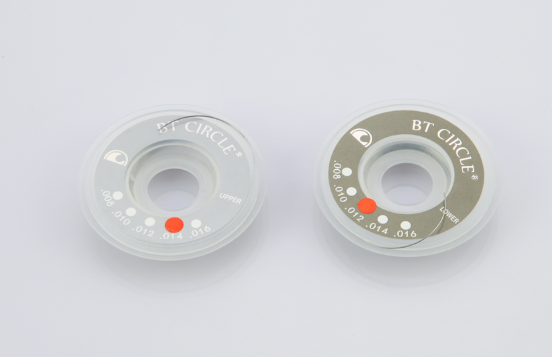
BT CIRCLE WIRE – L-Arch
-
Orthodontic function: Like all arch‑wires, BT Circle Wire helps apply gentle, continuous forces to teeth to guide them during alignment or stabilization.
-
Material options & biocompatibility: Arch‑wires (including products like BT Circle Wire) may be made from various alloys — common ones include stainless steel, nickel‑titanium (NiTi), and beta‑titanium. Each material has trade‑offs in stiffness, elasticity, resilience, and biocompatibility.
-
Elasticity / form‑memory / springiness: If BT Circle Wire uses a nickel–titanium (NiTi) alloy (common for many “Circle/Ti‑g‒” type wires), it likely benefits from shape‑memory or super‑elastic properties, making it suitable during early stages of orthodontic treatment where gentle, continuous forces and flexibility are needed.
-
Formability & adaptability: Arch‑wires should allow for bending, loops, or other adjustments (such as in “L‑Arch” shape) to match the patient’s dental arch geometry. Good formability ensures wires can be shaped to meet individual treatment needs before or during the treatment process.
-
General purpose / versatility: As part of a broad product lineup (arch‑wire, “roll type,” “M‑Arch,” “Sunny Wire,” etc.), BT Circle Wire seems intended for various treatment needs: initial alignment, archform shaping, or retention, depending on the shape/type chosen.
L-Arch (Round type)
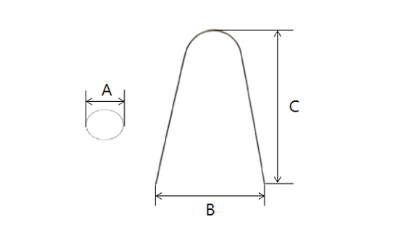
Specifications
| No. | Model Name | Diameter (Ø) | Length (mm) | Remarks | ||
|---|---|---|---|---|---|---|
| A | B | C | ||||
| 71 | BTLAW010F1 | 0.254 | 62 | 65 | public | |
| 72 | BTLAW012F1 | 0.305 | 62 | 65 | ||
| 73 | BTLAW013F1 | 0.33 | 62 | 65 | ||
| 74 | BTLAW014F1 | 0.356 | 62 | 65 | ||
| 75 | BTLAW016F1 | 0.406 | 62 | 65 | ||
| 76 | BTLAW018F1 | 0.457 | 62 | 65 | ||
| 77 | BTLAW020F1 | 0.508 | 62 | 65 | ||
| 78 | BTLAW010F2 | 0.254 | 63 | 66 | ||
| 79 | BTLAW012F2 | 0.305 | 63 | 66 | ||
| 80 | BTLAW013F2 | 0.33 | 63 | 66 | ||
| 81 | BTLAW014F2 | 0.356 | 63 | 66 | ||
| 82 | BTLAW016F2 | 0.406 | 63 | 66 | ||
| 83 | BTLAW018F2 | 0.457 | 63 | 66 | ||
| 84 | BTLAW020F2 | 0.508 | 63 | 66 | ||
L-Arch (React type)
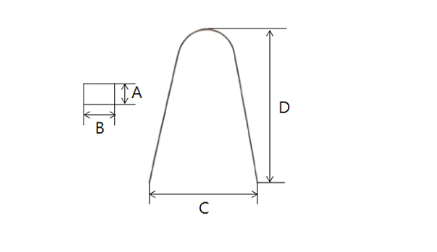
Specifications
| No. | Model Name | Diameter (Ø) | Length (mm) | Remarks | ||
|---|---|---|---|---|---|---|
| A | B | C | ||||
| 85 | BTLAW010F3 | 0.254 | 65 | 67 | public | |
| 86 | BTLAW012F3 | 0.305 | 65 | 67 | ||
| 87 | BTLAW013F3 | 0.33 | 65 | 67 | ||
| 88 | BTLAW014F3 | 0.356 | 65 | 67 | ||
| 89 | BTLAW016F3 | 0.406 | 65 | 67 | ||
| 90 | BTLAW018F3 | 0.457 | 65 | 67 | ||
| 91 | BTLAW020F3 | 0.508 | 65 | 67 | ||
| 92 | BTLAW010F4 | 0.254 | 68 | 68 | ||
| 93 | BTLAW012F4 | 0.305 | 68 | 68 | ||
| 94 | BTLAW013F4 | 0.33 | 68 | 68 | ||
| 95 | BTLAW014F4 | 0.356 | 68 | 68 | ||
| 96 | BTLAW016F4 | 0.406 | 68 | 68 | ||
| 97 | BTLAW018F4 | 0.457 | 68 | 68 | ||
| 98 | BTLAW020F4 | 0.508 | 68 | 68 | ||
| 99 | BTLAW010F5 | 0.254 | 71 | 69 | ||
| 100 | BTLAW012F5 | 0.305 | 71 | 69 | ||
| 101 | BTLAW013F5 | 0.33 | 71 | 69 | ||
| 102 | BTLAW014F5 | 0.356 | 71 | 69 | ||
| 103 | BTLAW016F5 | 0.406 | 71 | 69 | ||
| 104 | BTLAW018F5 | 0.457 | 71 | 69 | ||
| 105 | BTLAW020F5 | 0.508 | 71 | 69 | ||